Physics Overview
Consider two objects: the first a small ball and the second a large much more massive object - say a building. The latter object is at rest and its mass is many orders of magnitude greater than the mass of the small ball. Suppose you throw the ball at the wall of the building (for the sake of argument: perfectly horizontally), everyday experience tells you that you will find the ball comes straight back to you, reversing its initial path. The second object; the massive building, remains perfectly stationary.
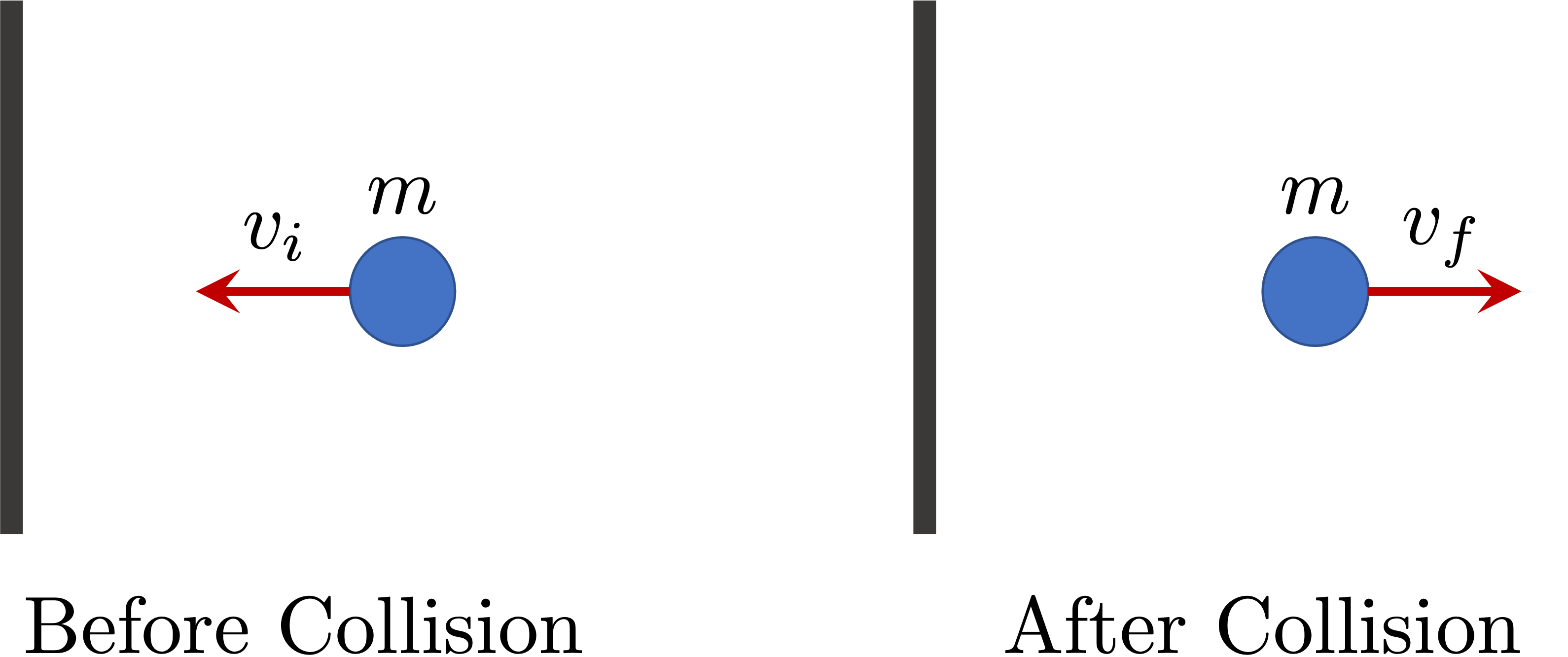
We can analyse the interaction between the two objects by studying the process of collision of the ball with (the wall of) the building. Consider the situation shown in Figure 1. The ball of mass \(m\), moves along a perfectly horizontal path and collides with an immobile wall with a horizontal velocity \(\vec{v}_i\). The process of collision between the two objects lasts on the order of a few miliseconds. Let us assume that during this short time interval, the interaction between the two objects is such that the incoming kinetic energy of the ball is converted to potential energy of deformation of the ball (mostly) and the wall. The objects deform momentarily and store potential energy in the deformation. This potential energy then gets converted to kinetic energy and by the end of the collision, the ball gains most of the kinetic energy, while the building continues in its state of rest. If the kinetic energy of the ball just before the collision is equal to the kinetic energy of the ball immediately after the collision, then the collision is a perfectly elastic collision. Such an idealised collision can be analysed by studying the kinetic energy and linear momentum of the system before and after the collision.
Let us first define the system as the ball and the wall of the building. We will ignore forces extraneous to the system, i.e., things like friction and gravity etc, simply don't exist in this idealization. Then, the process of collision is simply an interaction between two objects, and the forces that each object exerts on the other are completely internal to the system and form an action-reaction pair. Thus, the net force on the system is still zero, as these forces will sum to zero.
Therefore, we can examine the momentum of the system before and after collision. As can be seen in Figure 1, the only momentum that the system has prior to collision is by virtue of the ball; the momentum vector points to the left and has a magnitude \(mv_i\), as shown. Immediately after collision, the wall continues in its state of rest and the ball has a momentum pointing to the right, and let us assume that the speed of the ball is \(v_f\), hence the magnitude of the momentum is thus \(mv_f\). We can then write
\[ \vec{p}_i = -\vec{p}_f \implies m\vec{v}_i = -m\vec{v}_f. \label{eq:mom1} \]
This immediately yields,
\[ v_f~\hat{i} = -v_i~\hat{i}.\]
Which means that the velocity merely reverses direction, however the magnitude remains unaltered.
Examination of the kinetic energy is trivial and does not yield anything new as kinetic energy depends on the square of the speed, and the speeds of the ball are identical before and after the collision.
From the perspective of the small ball however, there is a net force on it. This net force is due to the wall exerting a force on the ball. This force has a time dependence and it begins as soon as the collision starts and ends when the collision ends. Thus there is an impulse force that is responsible for changing the momentum ball. We can essentially apply Newton's second law to write,
\[ \vec{F}_\textrm{im} = \frac{d\vec{\vec{p}}}{dt}, \label{eq:fim} \]
where \(F_\textrm{imp}\) is the impulse force that the wall exerts on the ball for the duration of the collision. Integrating Eq. \eqref{eq:fim} yields,
\[ \int_{t_{_i}}^{t_{_f}} \vec{F}_\textrm{im} dt = \vec{p_f} - \vec{p_i} \implies \Big|\int_{t_{_i}}^{t_{_f}} \vec{F}_\textrm{im} dt \Big| = |\vec{p_f} - \vec{p_i}| = 2mv_i, \label{eq:pchange} \]
where we have used Eq. \eqref{eq:mom1} in the last equality. This is what you will be confirming within experimental error in today's lab.
If you would like to get a quick video refresher about \(1-\)D elastic collisions see the following video.